Dog Days of Summer

When I was a young girl, I collected insects. Mostly the pretty ones; butterflies, moths and the like. I had the killing jars, the mounting boards and, thanks to my high school science teacher Mr. Orr, I had professional insect mounting pins – not my mom’s short stubby sewing pins. I had a great time foraging the woods and fields in my discovery quests. I loved to freak out my friends by placing a couple of empty cicada shells on my clothes – or for greater impact – on my friends! I was in seventh heaven when I took my entomology class in college.

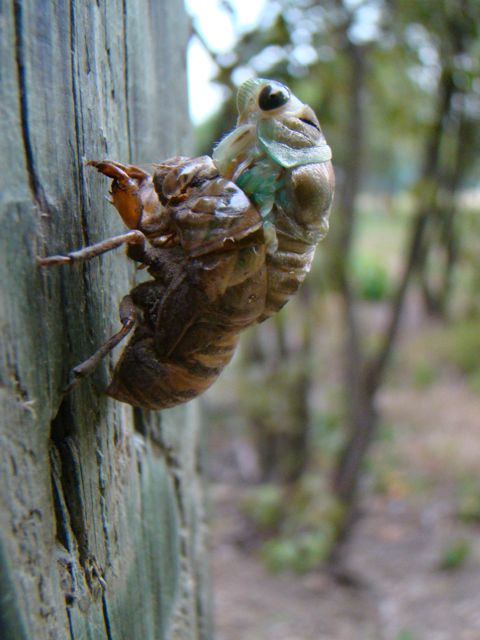
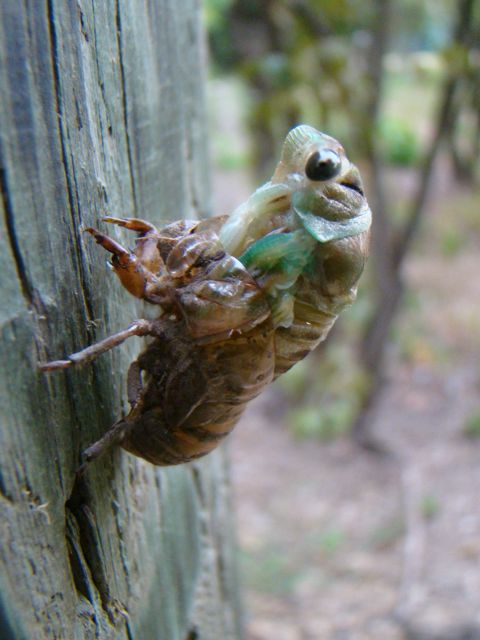
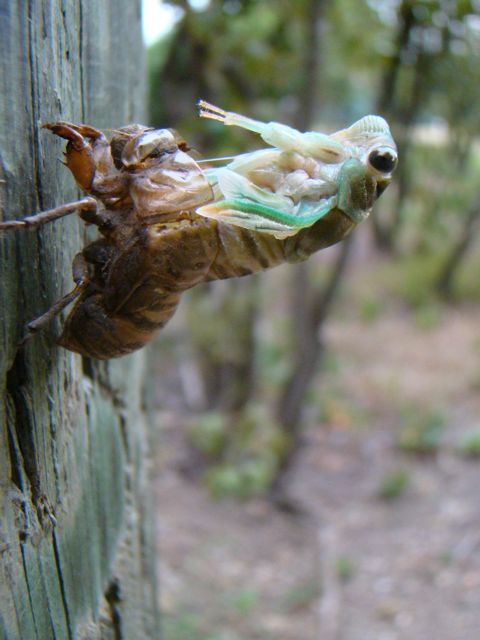
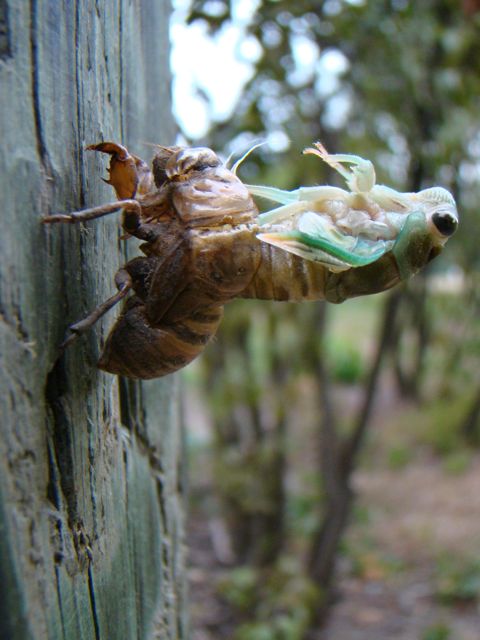
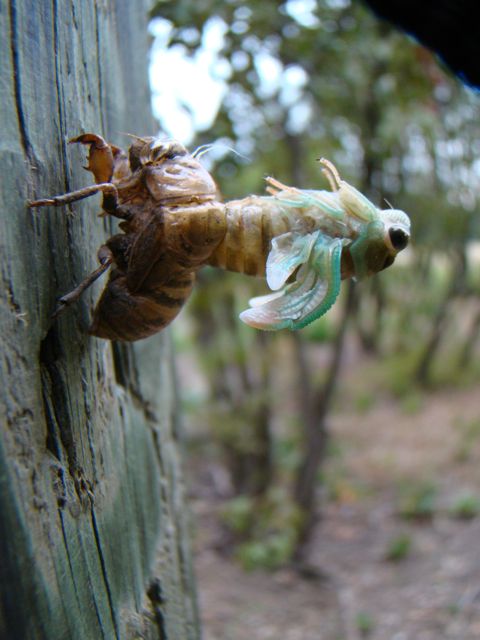
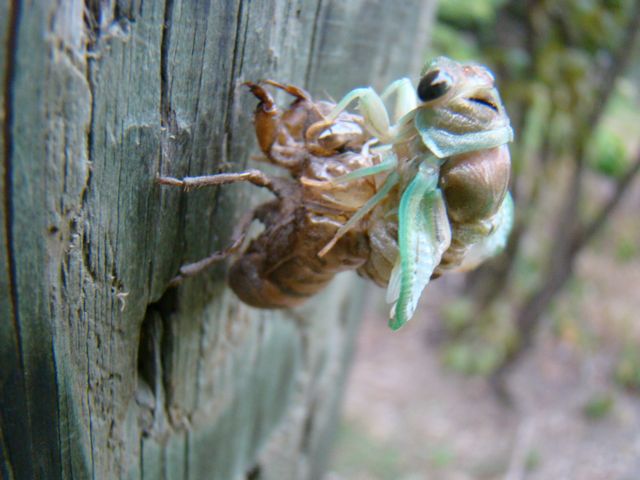
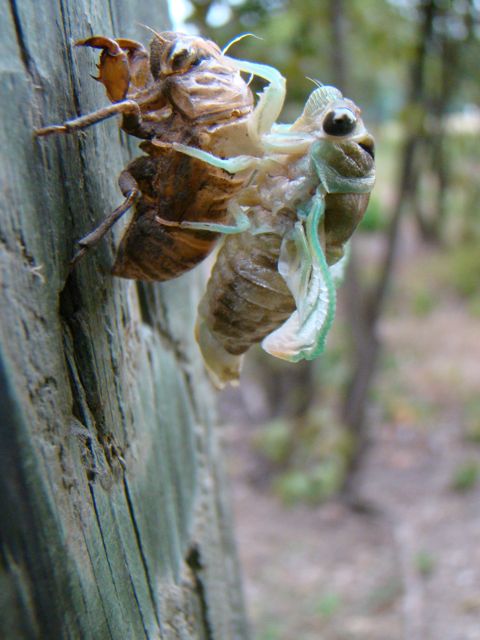
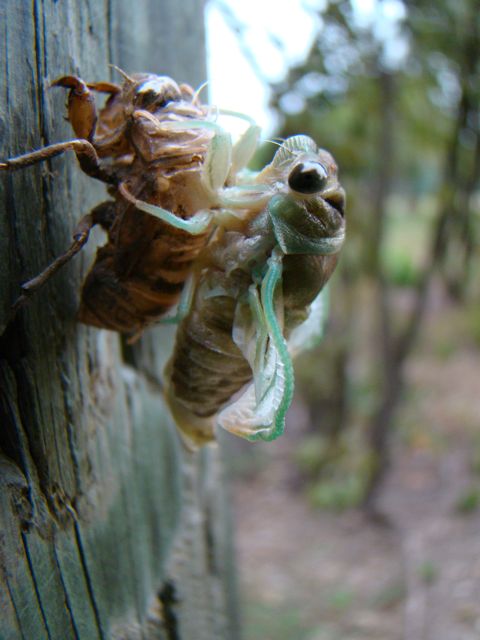
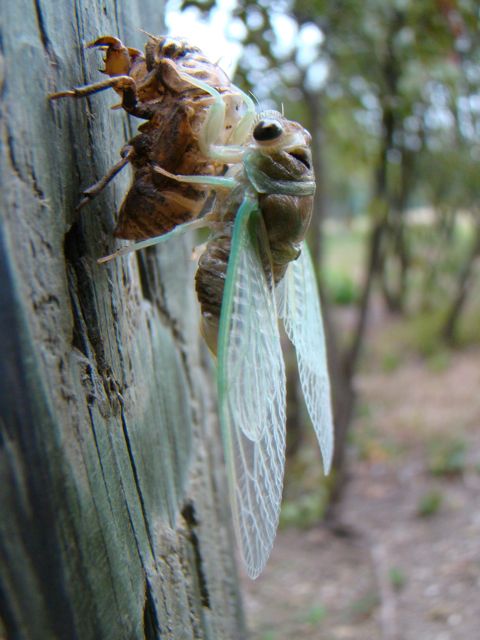
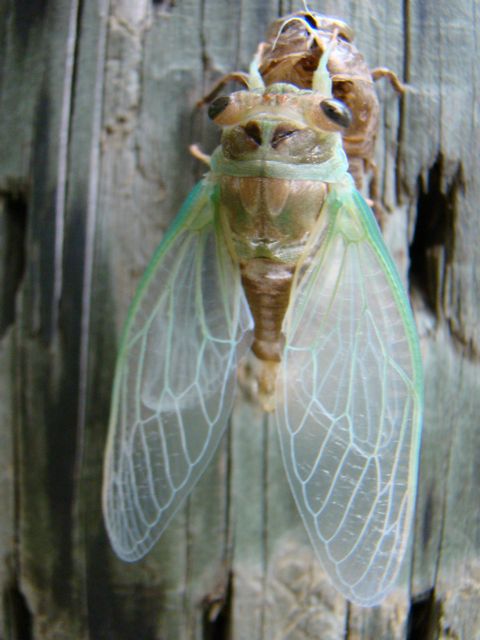
While tending to the ‘back 40’ last week I discovered an unusual sight: a newly emerged cicada nymph crawling on the ground. Bug geek that I am, I gave it a bit of help and placed it on a vertical surface to assist the molting process. I knew I was about to witness some cool stuff – the emergence of a dog-day cicada (Tibicen spp.).

If you want to skip the background on a cicada’s life-cycle, proceed to the photos below. A dog-day cicada starts its life when a mated female slices into a twig with her ovipositor and deposits her eggs. Newly hatched nymphs will drop to the ground and spend the next 2-5 years underground dining on root juices. Yum! (For comparison, the famous periodic cicada broods spend 13 or 17 years underground, depending on the species. Remember 2004?) They are very capable diggers and spend much of their life 1-8 feet down under chillin’ out. Lately, I’ve seen quite a few of the 1/2″ wide exit holes so the dog days of summer must be here. Under one hosta alone, I noted 8 empty shell cases.
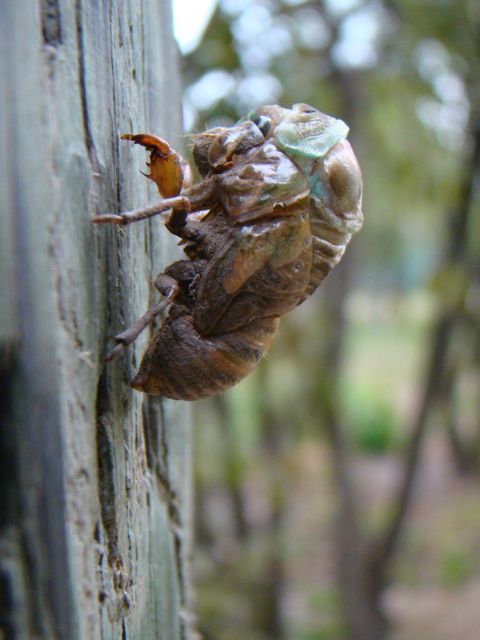
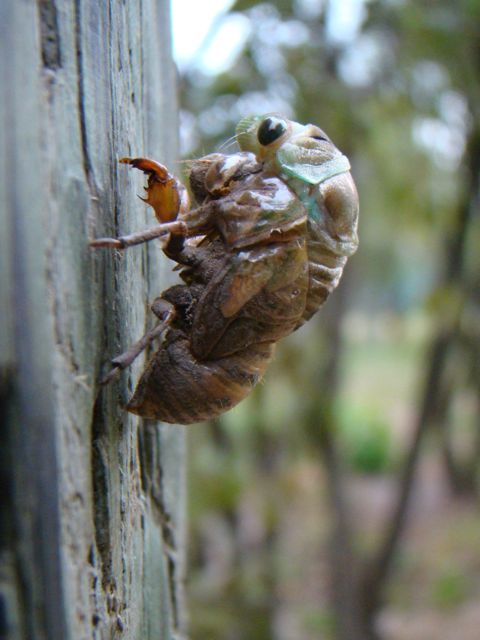
A face only a mother could love….

Bold Jumper spider (Phidippus audax)

With the exception of the beloved children’s book Charlotte’s Web, the mere thought or surprise presence of a spider evokes fear in most of us. Where does this fear come from? If we were more informed, that fear might (ok, maybe not for all of us) be replaced with respect.

Spiders are scientifically classified as arachnids (Class Arachnida). They differ from insects (Class Insecta) in several key ways. Primarily, insects have three body sections (head, abdomen and thorax) and six legs.  Spiders have two body sections (cephalothorax and abdomen) and eight legs. The front part is a combination of the head and thorax – hence the name cephalothorax. This part usually bears four pairs of eyes, four pairs of walking legs, a pair of smaller leg-like palps at the front. The spinnerets, which secrete the silk web strands, are located at the rear of the abdomen.

I have always found jumping spiders to be quite comical and easy-going. Sort of a spider version of a teddy bear. The accompanying photo is a close up one of the many species of jumping spiders found in Ohio: the Bold Jumper (Phipippus audax). Bold jumpers are very active and have a cute way of facing AND approaching any movement – even me! While trying to get a close up, this specimen would lift its forelegs and try to touch the camera. It even tried jumping on for a ride. The act of jumping toward you should not be perceived as an act of aggression; they rarely bite unless handled roughly. They spin no web but rather stalk their prey. They do, however, put down a silk dragline wherever they go as a sort of safety line in case of a fall.

Educational opportunity

The Greene County Master Gardeners are offering the program, “All About Herbs” from 8:30 am to 3:30 pm on Saturday, August 11, 2012 at the Xenia Church of the Nazarene (1204 E. Second St., Xenia OH 45385 ). Speakers and topics include: “Edible Gardening: Herbs, Vegetables Fruits and More” by Debra Knapke, Garden Designer, Lecturer, Author, Teacher; “Cooking With Herbs” by Candace Rinke, owner of The Hawthorn Grill in Kettering; ” Herbs and Container Gardening” by Susan Tyree, Meadowview Growers; “Herbs – Learn, Explore, Grow” by Susan Liechty, Delaware County Master Gardener; and “Herb Garden Design” by Cindy Hill, Greene County Master Gardener. Click HERE for the registration brochure.

Visit Belize without leaving Ohio

Join Rebecca Wood, Hopewood Holistic Health, and Kim Hupman, Horticulturalist-Master Gardener, for an evening of exploring gardens, foodways, and traditional use of common and uncommon plants of Belize. Discover common and not so common Pan-American Plants, their uses, traditions, ways to grow them and incorporate them into your home, landscape, and culinary endeavors.

Plant Lover’s Journey through the Plant Traditions, Gardens and Cultures of Belize

Tuesday, July 24th from 6:30-9:00 pm, in the Fireside Room of the  Xenia Nazarene Church (1204 West Second St., Xenia, OH 45385).

You will taste, feel, see and smell your way through this presentation and learn how you can join in on the adventure with upcoming International Eco-Culinary and Garden Tours. This event is co-sponsored by the Master Gardeners and the OSU/Greene County Extension. For more information contact: Barbra Mills (mills.35@cfaes.osu.edu) or Rebecca Wood (becaherbtravel@gmail.com)


Water Garden Tour

The Miami Valley Water Garden Society is having a self-guided Public Pond Tour on Saturday, July 28 and Sunday, July 29. The tour will be from 10:00 am till 5:00 pm on Saturday and 11:00 am till 5:00 pm on Sunday. There will be 11 private water gardens to see. These gardens are located in Franklin, Centerville, Bellbrook, Dayton, Beavercreek, New Carlisle, West Alexandria and Eaton. For ticket information please call (937) 428-9564 or go to http://www.mvwgs.org.

Long time no see

Two months have flown by since my last post. Volleyball season finished (hubby coaches, I photograph), the backyard honeysuckle fencerow was removed and replanted and then…..there was a hospital visit. Emergency. Come to think of it, I’ve accompanied two people to emergency, lately. The first was when I drove to the hospital like a mad woman with dear hubby in tow. Let’s just say that our huge ‘Skyline’ locust tree didn’t like being limbed up and took out the chainsaw operator AND the ladder upon which said operator was standing with vengeance. End result? Over $8K in medical charges and a broken bone in his face. He is so very lucky it wasn’t worse. The second opportunity to visit another emergency room was when I accompanied my mom in the squad car after she suffered a heart attack at church. She’s home resting and will recover with time and new meds. And if she listens to her doctor. Easier said than done!

Hummingbird nest

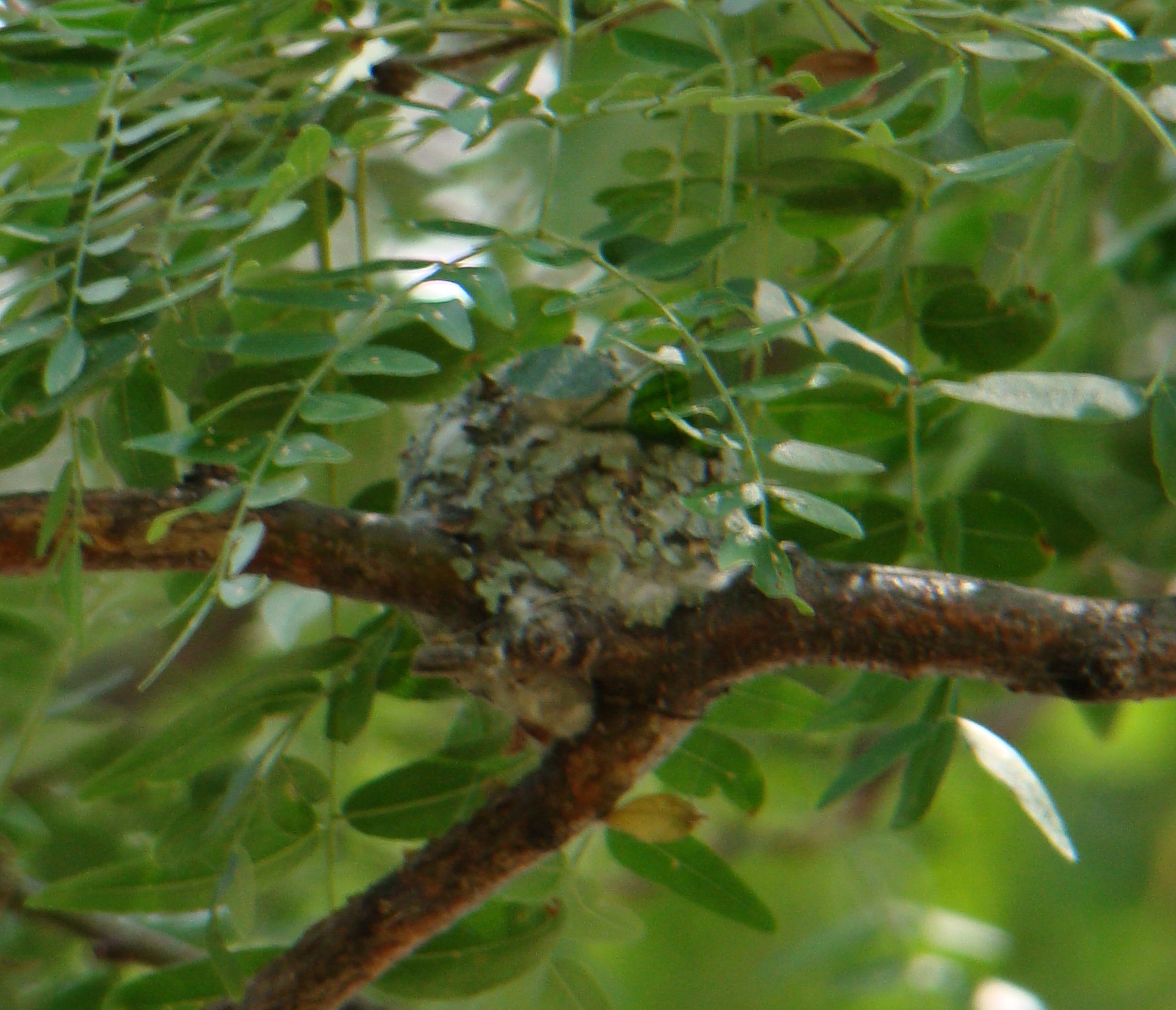
Miracles abound. Take, for instance, the vengeful locust tree. She now is protecting a miniature cup woven with fluffy down and held together with spider webs; she holds a hummingbird nest in her branches. I discovered the location this past Sunday by following a female who was gathering fluff from my nesting material cage. If only the nest was closer to the ground – it sits about 10-12′ above my head.

Nesting Material Cage

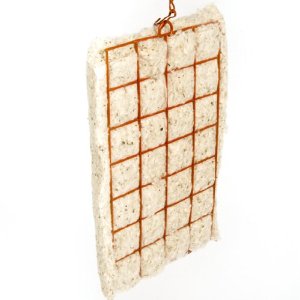
The American goldfinches are just now getting into the nest-making mode and are also making a dent in the fluffy stuff. Check out one of the dispensers sold at your local Wild Birds Unlimited store. Nesting birds will thank you.

Sales alerts

Seasonal sales going on: Check out your local garden center/nursery for some fantastic sales. As they say at my favorite place to eat (Hot Head Burritos), “Get out and get you some!” Some of the sales/discounts going on that I am aware of are:

Knollwood Garden Center – 25% off store wide and 50% off select items.

Grandma’s Gardens –  vegetable plants, flats of annuals, flowering almonds, fruit trees and 1.75″ caliper ‘Sargentina’ crabapples are 50% off;  2.5″ caliper ‘Bosque’ elm trees and 5-6′ ‘Autumn Brilliance’ serviceberrys  are 30% off; 4″ annuals, tropicals and in-stock azaleas are 25% off; variegated red twig dogwood (reg. $29.99) are now $19.99; $7.99 1-gallon perennials of the week include ‘Walker’s Low’ Catmint and Blue Star Creeper

Siebenthaler’s Garden Center – all annuals, herbs, vegetables and tropicals are 30% off.